
John Holmes to speak on no- and low-alcohol drinks in SHAAP seminar
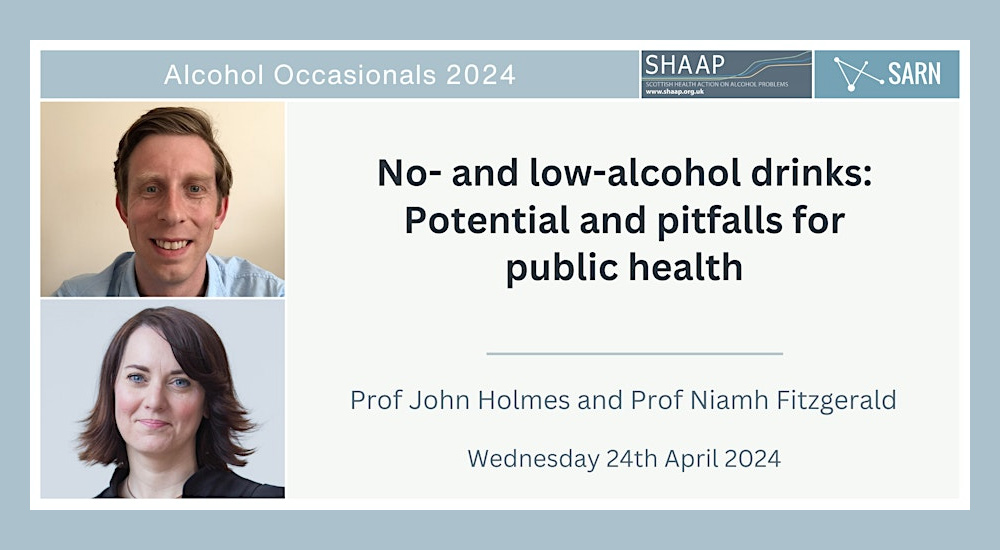
Prof John Holmes and Prof Niamh Fitzgerald will discuss the implications of no- and low-alcohol products for public health in a free online seminar on 24 April.
The seminar forms part of the 'Alcohol Occasionals' series organised by Scottish Health Action on Alcohol Problems (SHAAP) and the Scottish Alcohol Research Network (SARN).
Drawing on work from the NIHR-funded project 'Evaluating and responding to the public health impact of no and low alcohol drinks: A multi-method study of a complex intervention in a complex system', John and Niamh will speak about 'No- and low-alcohol drinks: potentials and pitfalls for public health'.
About the seminar
No- and low-alcohol (no/lo) drinks have become increasingly popular with consumers in recent years and the UK Government is committed to growing the no/lo market. No/lo drinks may have substantial health benefits if used in place of standard alcoholic drinks, but public health actors are concerned about risks including surrogate marketing, policy substitution and harmful effects on vulnerable groups.
During the seminar John and Niamh will discuss the pathways to benefits or risks for public health arising from the rise in no/lo drinks in the UK; present new quantitative data on trends and social patterns in sales, purchasing and consumption of no/lo drinks; and argue for a unified public health response to no/lo drinks.
About the speakers
John Holmes is Professor of Alcohol Policy at the University of Sheffield and Director of the Sheffield Addictions Research Group. He is also co-Director of the NIHR Policy Research Unit in Addictions.
Niamh Fitzgerald is a Professor of Alcohol Policy and Director of the Institute for Social Marketing and Health at University of Stirling. She is also Deputy Director of the SPECTRUM (Shaping public health policies to reduce inequalities and harm) research consortium (2019-2024), with responsibility for impact, knowledge exchange and public engagement.
Registration
The seminar will take place online on Wednesday 24 April 2024, 12:45pm – 2pm. Visit Eventbrite to register for free.
-
Tobacco company levy could raise up to £4.9bn and prevent 10,000 hospital admissions, study suggests
New modelling from the Sheffield Addictions Research Group shows a 'polluter pays' levy scheme could cut smoking deaths, reduce hospital admissions, and raise billions in tax revenue.
-
SARG researchers lead UK's biggest effort to tackle gambling harms
A major new national effort to tackle gambling harms and shape future policy, prevention and treatment across the UK is being led by researchers from the Sheffield Addictions Research Group.
-
Later pub opening hours linked to surge in alcohol-related ambulance call-outs and crime
Extending late-night opening hours for pubs and bars can lead to a significant increase in alcohol-related ambulance call-outs and reported crime, according to new research involving the Sheffield Addictions Research Group (SARG).
-
New SARG study finds young people are three times more likely to start with alcohol than no/lo alternatives
New research from the Sheffield Addictions Research Group (SARG) and University College London (UCL) has found that young people aged 16-25 in Great Britain are three times more likely to start drinking alcohol than alcohol-free and low-alcohol (no/lo) alternatives.
You might also be interested in…
-
Sheffield Addictions Research Group to present at KBS Alcohol Epidemiology Symposium
A team of nine will be travelling from Sheffield to Australia in May to share their work with alcohol researchers from across the world.
-
John Holmes to speak at MCA Annual Symposium
SARG Director Professor John Holmes will give a talk on no/lo drinks at the Medical Council on Alcohol's Annual Symposium this week (22.11.23).
-
SARG's Lucy Burke wins Open Research Prize 2025
Lucy Burke, a Qualitative Research Associate and PhD Student with the Sheffield Addictions Research Group (SARG), has been awarded the University of Sheffield Open Research Prize 2025 in the Postgraduate Researcher (PGR) category.