
This blog post was written by Colin Angus with contributions from John Holmes, Ellen McGrane, Esther Moore and Damon Morris.
The Great British pub plays a key role in many people's concept of our national identity. Pubs, however, are facing an existential threat, with the number in the UK having fallen by a fifth between 2009 and 2022, and stories of pub closures a regular feature in local and national news. This trend preceded the COVID-19 pandemic, but the forced closure of pubs during lockdowns and subsequent restrictions on and public concerns about social interactions placed further strain on the hospitality industry.
Policy attempts to stem the decline
Previous administrations have taken steps to try to address this decline, including temporary cuts to business rates for the hospitality sector during the pandemic, the introduction of 'draught relief' – a lower rate of alcohol duty for many products sold in pubs – as part of alcohol tax reforms introduced in 2023, and recent plans from Keir Starmer's government to allow pubs to stay open later at night.
Most recently, on 23 July 2026, one of Andy Burnham's first acts as Prime Minister was to announce a 20% cut in business rates for pubs, clubs and live music venues.
The rationale behind the intervention
Why then might Andy Burnham feel that further action is needed?
Firstly, because the ending of the pandemic-era business rate relief has coincided with new increases in business rates (i.e. local taxes on commercial properties) for many pubs.
Secondly, because the impact of the draught relief is likely to be relatively limited, with the relief equating to a roughly 7p cut in the tax payable on a standard pint of beer. Even if pubs are pocketing all of this, rather than passing the savings on to customers, this is unlikely to represent a huge windfall for publicans.
Finally, the proposed later opening hours haven't come into force yet, but evidence from a recent study in Scotland suggests that increases in late night opening hours for bars and clubs in Glasgow and Aberdeen did not lead to obvious benefits for venue owners as the extra hours were not hugely popular with patrons. As an added concern, linked analysis from the same project found that the later pub opening hours were associated with an increase in both late-night ambulance call-outs and reported crimes, suggesting that later opening hours had a clear societal cost without delivering the desired economic benefits.
The economic value of the hospitality sector
This invites the question of whether pubs could be an effective engine for economic growth, over and above the sense they are a national institution that many people want to protect.
A recent SARG study explored this question and found that the hospitality sector is one of the most productive in the economy with large economic multiplier effects that contribute to economic growth because it is labour intensive and has large supply chain impacts – although it is less clear how much this is driven by pubs as opposed to other hospitality businesses such as restaurants and cafes. Nonetheless, it is possible that helping the pub will support jobs and local economic activity.
Cultural shifts and changing drinking habits
If boosting the pub sector might be an economic winner, then why is it so hard to achieve? One issue is the obvious public health and wider societal costs associated with increased alcohol consumption. This makes the case for supporting pubs more complex, but pubs are also battling significant cultural headwinds.
Drinking in the UK has shifted dramatically in recent decades from the pub to our homes. Just over 30 years ago, around 60% of all alcohol was drunk in pubs, bars, clubs and restaurants. In 2024, it was just 26%, with the total amount of alcohol drunk in pubs and bars having halved since 2000.
This shift reflects many factors, including changing workplace cultures that previously supported lunchtime and post-work drinks, the growth of home-based entertainment, the greater involvement of men in family life and changing consumer preferences, including a fall in young people's drinking – which has always been more associated with pubs and bars – and a corresponding rise in older adults' drinking, which has tended to take place in the home.
Increases in price and availability
At the same time, it is impossible to ignore the role that prices may have played in these trends. Alcohol has always been cheaper to buy in shops than in pubs, but the gap has risen, with the affordability of shop-bought alcohol quadrupling since the late 1980s, compared to a doubling of the affordability of alcohol in pubs and bars.
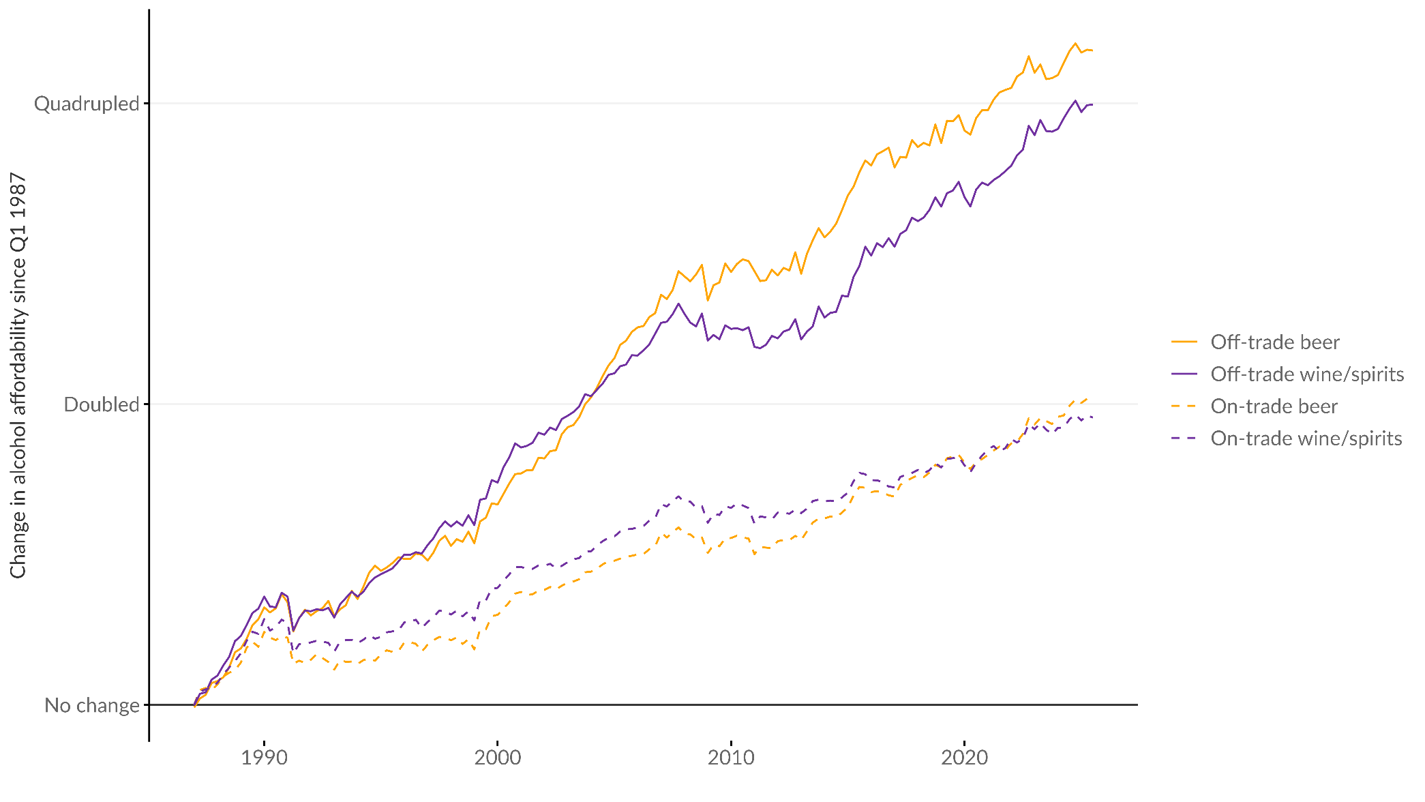
Change in alcohol affordability since Q1 1987.
The number of shops selling alcohol has also risen steadily, increasing by 25% since 2009 alone. The threat of widely available low-priced alcohol in shops has topped the list of concerns that publicans themselves have about the future of their business. In view of this, while Andy Burnham's proposal to reduce business rates for pubs is likely to provide a small financial boost, it doesn't address the biggest issue facing the sector – something that is reflected in the industry's rather lukewarm response to the announcement.
Funding the cuts by taxing other harmful businesses
However, the potential impact on pubs isn't the only interesting aspect of these proposals. Andy Burnham has also suggested that the business rate cuts could be funded by reducing tax reliefs for vape shops and gambling outlets.
In marked contrast to the economic benefits of boosting the hospitality sector, the SARG research referred to earlier found that money spent on gambling is far less productive than other types of consumer spending, while spending on tobacco generates virtually zero positive economic impact. In general, therefore, boosting spending in pubs at the expense of gambling and tobacco is almost certainly good for economic growth.
Shifting the tax burden onto businesses which, in Burnham's words, 'do not make a positive contribution to local economies' would likely prove popular. Indeed, public opinion polling indicates that nearly two-thirds of British adults think there are too many vape shops on their local high streets, and people may prefer an empty shopfront to a new gambling outlet on their local high street.
Reducing business rate reliefs for vape shops could increase operational overheads, potentially leading to higher prices and reduced product availability. While this risks negative economic consequences if it leads to store closures, selling vapes remains significantly less productive and labour-intensive than the hospitality sector. Consequently, any high-street losses from vape sales could be effectively offset if a revived pub sector generates increased footfall for local businesses.
Similar arguments apply to reducing tax relief for gambling outlets. The UK gambling industry argues that these businesses make a valuable contribution to the economy, and reducing their profitability could result in the closure of some betting shops. However, it could also redirect consumer spending to more productive sectors of the economy.
Public health considerations
There are also potential public health impacts of increased taxes on gambling and vape shops to consider.
Reduced availability of cheap vaping products could yield public health benefits by reducing the number of young people taking up vaping and becoming addicted to nicotine – a potential gateway to smoking tobacco. There may, however, be adverse effects on adults who smoke for whom vaping can be an effective way to transition away from smoking tobacco. They may be less likely to attempt to quit smoking, or more likely to relapse back to smoking, if vaping products become more difficult or expensive to obtain.
Research highlights the association between betting shops, gaming machines, higher risk gambling, and deprivation, with clustering of shops in more deprived areas. A reduction in the number of gambling outlets could help reduce gambling-related inequalities if it leads to lower levels of gambling participation.
In summary
On balance, the new Prime Minister's proposed changes to business rates seem relatively sensible from an economic perspective, with the potential to shift consumer spending from lower- to higher-value sectors of the economy.
The public health impacts are less clear, although it is positive that the relief to pubs isn't being implemented in a way that directly incentivises them to increase alcohol sales (as would be the case if pubs were supported by increasing the scale of draught relief).
What is clear, however, is that broader economic and cultural shifts have produced these tough times for pubs, and it is unlikely that the announced cut in business rates will do much to push back against these changes.