

The rapid rise in e-cigarette use among young people has become a major talking point in the UK. While vapes can be a helpful tool for adults looking to quit smoking, the increasing number of young people who have never smoked taking up vaping is a significant public health concern.
In response, the UK government is introducing a range of new regulations, from banning disposable vapes to introducing a new vaping products duty. To evaluate the potential effectiveness of such policies, it is helpful to systematically understand the factors facilitating young people's use of vapes.
Using the 'five dimensions of access'
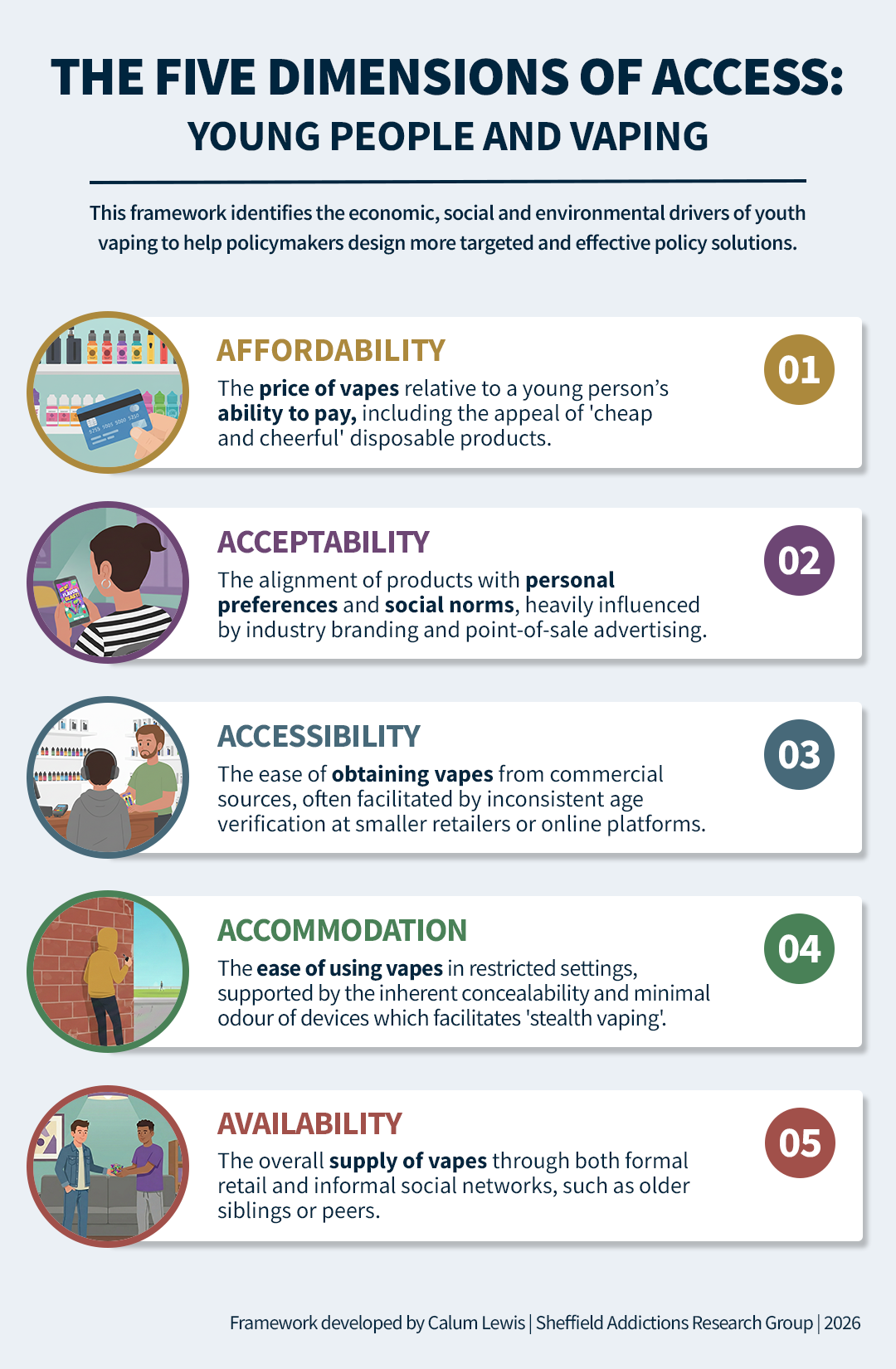
In our latest study, we conducted a systematic review of European research to look at vaping among 11-17 year olds through the lens of the five dimensions of access. This framework, originally designed for healthcare, allowed us to break down the factors influencing youth use into five areas:
- Affordability: The price of vapes relative to a young person's ability to pay, including the appeal of 'cheap and cheerful' disposable products.
- Acceptability: The alignment of products with personal preferences and social norms, heavily influenced by industry branding and point-of-sale advertising.
- Accessibility: The ease of obtaining vapes from commercial sources, often facilitated by inconsistent age verification at smaller retailers or online platforms.
- Accommodation: The ease of using vapes in restricted settings, supported by the inherent concealability and minimal odour of devices which facilitates 'stealth vaping'.
- Availability: The overall supply of vapes through both formal retail and informal social networks, such as older siblings or peers.
What our research found: implications for policy
Our research indicates that national policy is most effective when targeted at certain dimensions of product regulation. Affordability (via taxation), acceptability (via marketing restrictions), and accessibility (via retailer licensing) represent the primary leverage points for government intervention. These findings align with the current policy context: the government is scheduled to introduce an e-liquid tax in October 2026, while the Tobacco and Vapes Bill provides the necessary powers to regulate point-of-sale displays and implement formal retailer licensing.
Conversely, accommodation remains a significant challenge for policy. Because e-cigarettes are inherently discreet and easy to conceal, regulating their use through traditional 'vape-free' spaces can be difficult. Evidence shows that school-level bans often have limited impact because students can circumvent these rules through 'stealth vaping' in classrooms or bathrooms. This challenge is particularly relevant in the current policy context, as the government is consulting on proposals to introduce new smoke-free, heated tobacco-free and vape-free public spaces in England, including outdoor areas and education settings.
There could also be implications for local policy. By engaging directly with young people local authorities can identify specific geographical pressure points that may not be visible to national policymakers. This approach allows for targeted enforcement at specific retail outlets, such as corner shops where young people perceive age verification to be weak. By focusing on these accessibility challenges, local authorities can complement broader national regulations to more effectively reduce young people's e-cigarette usage.
Why this framework matters
The five dimensions of access framework provides a flexible way to think about emerging nicotine products and different regulatory contexts. For emerging products like nicotine pouches, which offer even greater accommodation (concealability) than vapes, the framework could suggest shifting policy focus toward other dimensions like acceptability or accessibility. Internationally, the framework can be used to analyse different regulatory systems; for instance, examining how Australia's prescription-only model for e-cigarettes shifts availability toward illicit markets and social supply.
Next steps: Modelling the future of youth nicotine policy
Our review also highlights important evidence gaps. While many studies examine individual dimensions such as acceptability, there is still limited understanding of how different access dimensions interact when new policies are introduced or how regulatory changes translate into real-world behaviour.
To bridge these gaps, we are translating our findings, alongside insights from workshops with young people, into a mathematical 'Youth Nicotine Policy Model'. This modelling aligns itself with the recommendations from the SPIRE project, which called for robust modelling on price-based, place-based, and prescriptive policies.
Our initial focus will be on estimating the potential impact of upcoming pricing changes, with the aim of supporting future evaluation once policies come into effect. In the longer term, the model could be adapted to explore a wider range of regulatory scenarios, providing a tool to help policymakers anticipate how changes across multiple dimensions of access may influence youth nicotine use.
Further reading
SARG research and projects
- Access-related factors and e-cigarette use among 11–17-year-olds: a thematic synthesis of European studies using the five dimensions of access – the full peer-reviewed study examining the five dimensions of access in a European context.
- UK vaping policy modelling: Key findings from the SPIRE project – blog post by Professor Hazel Squires, co-lead of the SPIRE project which aimed to identify the requirements for a UK vaping policy model, map out existing data that could feed into the model, and identify what additional data are needed.
- Creating a Smokefree Generation: The role of universities in supporting the Tobacco and Vapes Bill – blog post in which Dr Duncan Gillespie discusses the UK Government's Smokefree Generation policy, highlights Sheffield's student-led research and advocates for a national university network to share best practices for creating smoke-free environments.
- The SPIRE project – more information about this project led by the University of Sheffield and UCL.
- The STAR project – a project led by the University of Sheffield which focuses on including youth voices in local authority responses to new national tobacco and vaping legislation.
National policy and legislation
- Tobacco and Vapes Bill 2024 – details of the proposed legislation to create a smoke-free generation and regulate vaping products.
- Vaping products duty – information on the new tax on e-liquids scheduled for introduction in October 2026.
- Ban on disposable vapes – government announcement regarding the crackdown on single-use vaping products.
- Consultation on smoke-free and vape-free spaces – the current government consultation on extending restrictions to outdoor areas and education settings.
Supporting evidence and frameworks
- BBC News: The rise of youth vaping – media coverage highlighting the public health concerns and policy debate surrounding e-cigarettes.
- ASH: Use of e-cigarettes among young people in Great Britain – statistical data and trends regarding youth vaping uptake and behaviours.
- The Concept of Access – the original 1981 academic paper by Penchansky and Thomas defining the five dimensions of access.
Calum Lewis is a PhD student in the Wellcome Trust Doctoral Training Centre in Public Health Economics and Decision Science at the University of Sheffield.
This blog post was based on the following paper:
Lewis C, Gallagher C, Fairbrother H et al (2026) Access-related factors and e-cigarette use among 11–17-year-olds: a thematic synthesis of European studies using the five dimensions of access BMC Public Health DOI: https://doi.org/10.1186/s12889-026-26692-y