
Sheffield smoking cessation research on the agenda at national ASH webinar
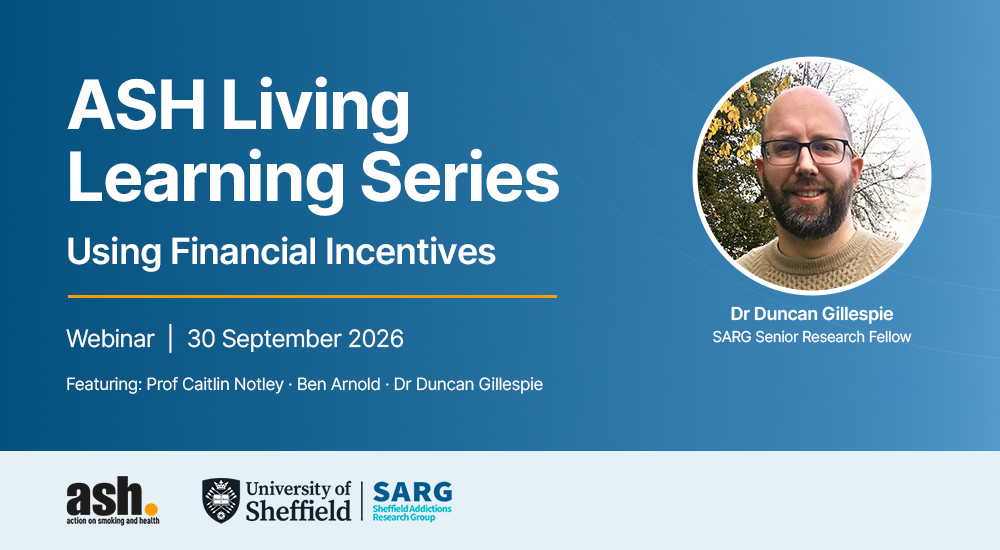
University of Sheffield research evaluating the use of financial incentives to help people quit smoking in Sheffield has featured at a national webinar hosted by Action on Smoking and Health (ASH).
The webinar, held on 30 September, was the first in ASH's new Living Learning Series, which follows on from its Ending smoking inequality: An action plan to reduce poverty and improve health report. The series brings together academic evidence and practical experience to explore interventions that can help reduce smoking inequalities and increase quit rates.
The session focused on the use of financial incentives to support people to stop smoking. Professor Caitlin Notley, Professor of Addiction Sciences at the University of East Anglia, presented findings from the latest Cochrane review of incentives for smoking cessation, before Ben Arnold, Health Improvement Principal (Tobacco Control) at Sheffield City Council, presented findings from a University of Sheffield evaluation of the Council's financial incentive pilot. SARG Senior Research Fellow Dr Duncan Gillespie, one of the researchers who carried out the evaluation, joined the session to discuss the findings and answer questions.
Evaluating Sheffield's financial incentive scheme
Between October 2024 and March 2025, Sheffield City Council piloted a scheme offering shopping vouchers to people using the Smokefree Sheffield service who were living in social housing, had a mental health condition, or were receiving drug and alcohol treatment.
Participants could receive up to £200 in staged incentives for setting a quit date and remaining smoke-free, verified through carbon monoxide breath tests.
University of Sheffield researchers Dr Nick Woodrow, Dr Joe Hulin and Dr Duncan Gillespie evaluated the pilot using routine service data alongside interviews with service users and staff. Their report, published in May 2026, found that among people who made a quit attempt, 58% of those receiving incentives were smoke-free at 12 weeks, compared with 42% of those who did not receive them.
The interviews also suggested that the staged vouchers helped keep people engaged during the difficult early weeks of quitting. Service users generally described the vouchers as an additional benefit rather than their main motivation, with health, family, support from a trusted adviser and access to nicotine replacement therapy and vapes also important.
The evaluation also identified practical lessons for delivering incentive schemes, including the need for alternatives to digital vouchers, prompt payment of rewards, clearer communication about eligibility and stronger referral pathways between services.
From research evidence to local practice
The Sheffield findings complement wider international evidence showing that financial incentives can help people quit smoking. The updated Cochrane review presented during the webinar found high-certainty evidence that incentives improve long-term smoking cessation rates and that their benefits continue after incentives end.
The evaluation was commissioned by Sheffield City Council and co-designed with council public health colleagues, with the University of Sheffield team independently carrying out the analysis and reporting. The work builds on an ongoing partnership between SARG and the council to connect research evidence with local tobacco control policy and practice.
Greg Fell, Director of Public Health for Sheffield, said:
"The results of this study are very interesting, and we will use them to further inform our stop smoking work in Sheffield and across the region. This is vitally important work. We're here to help people quit smoking in the best ways to help them stay healthy. Health inequality is hard to tackle, but work like this helps enormously towards our goal of ending health inequality for all."
Dr Duncan Gillespie said:
"The wider evidence tells us that financial incentives can help people quit smoking, but councils also need to know how to make them work in practice. Sheffield's pilot gives us valuable insight into what works locally, where the challenges are, and how schemes like this can be improved."
The webinar was the first of six lunchtime sessions in ASH's Living Learning Series. Future sessions will explore approaches including vaping and harm reduction for adult smokers, social housing and community-based interventions.
Find out more
- Watch the ASH webinar: Using Financial Incentives
- Read the full evaluation report: Sheffield City Council's Pilot Financial Incentive Scheme for Smoking Cessation in Priority Groups: A Mixed Methods Evaluation
- Find out more about the evaluation on the SARG website
- Read the Smokefree Sheffield news release: Paid to quit: New Sheffield study proves financial rewards help people quit smoking
-
SARG and IAS partner to lead session at Portorož Youth Health Forum 2026
Dr Laura Fenton, Research Fellow at the Sheffield Addictions Research Group (SARG), and Dr Peter Rice, Chair of the Institute of Alcohol Studies (IAS) and President of Eurocare, will co-lead an interactive session at the Portorož Youth Health Forum 2026 in Slovenia.
-
The higher cost of a healthier option: SARG study lifts the lid on why no/lo alcohol beer drinkers feel out of pocket
People buying alcohol-free and low-alcohol beers pay more for choosing a healthier option, according to new research by the Sheffield Addictions Research Group (SARG).
-
Tobacco company levy could raise up to £4.9bn and prevent 10,000 hospital admissions, study suggests
New modelling from the Sheffield Addictions Research Group shows a 'polluter pays' levy scheme could cut smoking deaths, reduce hospital admissions, and raise billions in tax revenue.
-
SARG researchers lead UK's biggest effort to tackle gambling harms
A major new national effort to tackle gambling harms and shape future policy, prevention and treatment across the UK is being led by researchers from the Sheffield Addictions Research Group.
You might also be interested in…
-
Choice and flexibility are key factors to support stopping smoking
An evaluation of a smoking cessation service by Sheffield researchers highlights the importance of flexible support to engage with different groups and support their individual needs.
-
Evaluating Sheffield City Council's smoking cessation incentive scheme for priority groups
This project is evaluating Sheffield City Council's smoking cessation incentive scheme for priority groups, aiming to assess its effectiveness and inform future service improvements.
-
SARG contributes to major new report on e-cigarettes
The Sheffield Addictions Research Group has contributed to a major new report on e-cigarettes from the Royal College of Physicians.